Water damage doesn’t pause while you decide what to do next. Within the first few hours of a burst pipe, storm event, or appliance failure, water actively penetrates carpet fibres, wall cavities, subfloor timbers, and plasterboard. By the time moisture is visible on the surface, it’s almost always already spread further than it looks.
The longer water sits, the more damage compounds. What starts as a wet floor can become warped timber, swollen plasterboard, and a full mould infestation within 48 to 72 hours. The cost of professional emergency water extraction in Perth in the first few hours is a fraction of what remediation costs once secondary damage sets in.
Speed, the right equipment, and certified know-how are the three things that determine whether your property recovers cleanly or carries lasting damage. That’s why professional water removal services exist, and why a domestic wet-vac is rarely the right answer.
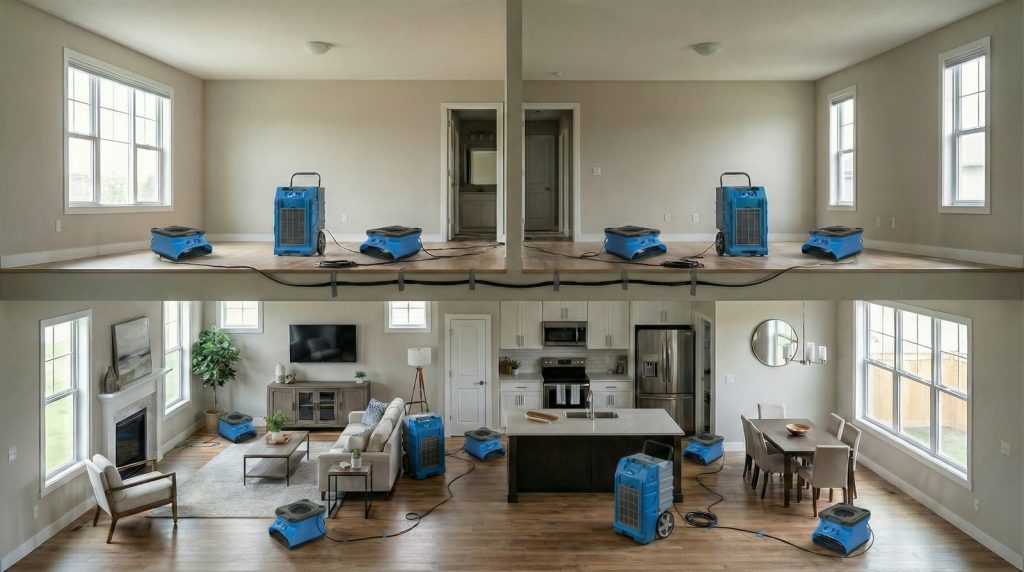
What Professional Water Extraction Equipment Actually Does
Professional service for water extraction in Perth rely on a combination of industrial-grade tools working in sequence. It’s not one machine doing one job. It’s a coordinated system designed to pull moisture from every layer of your property.
Here’s how that system works, step by step.
1. Thermal Imaging and Moisture Detection
Before a single litre of water is removed, qualified technicians map the full extent of the damage. Thermal imaging cameras detect temperature differentials caused by moisture hidden behind walls, beneath floors, and inside ceiling cavities. Calibrated moisture metres then take readings from timber, concrete, plasterboard, and carpet to establish a clear baseline.
This step is critical. Skipping it means treating only what you can see, and water damage is rarely limited to what’s visible.
2. Truck-Mounted Extraction Units
The centrepiece of emergency water extraction in Perth is the truck-mounted extraction unit. These machines generate suction power measured in hundreds of waterlift inches, far exceeding anything available for consumer hire.
A standard wet-vac operates at roughly 80 to 100 inches of waterlift. A truck-mounted extraction unit operates at 200 inches or above, and some commercial units exceed 300 inches. That suction capacity is what allows water to be pulled not just from carpet fibres, but from the underlay, the subfloor, and structural materials below.
For emergency water removal in Perth involving standing water, submersible pumps work alongside extraction units to remove bulk water rapidly before the detailed extraction phase begins.
3. High-Velocity Air Movers
Once standing water is removed, the drying phase begins. Industrial air movers create directed, high-speed airflow across wet surfaces. Unlike a household fan, which simply circulates ambient air, high-velocity air movers produce a thin, fast-moving layer of air directly against the surface of wet materials. This dramatically accelerates evaporation from fibres and structural materials.
The positioning of air movers is not arbitrary. Trained technicians place them at precise angles and distances based on the material type and moisture readings from the initial assessment.
4. LGR Dehumidifiers
Evaporation moves moisture from surfaces into the air. Left unaddressed, that moisture-laden air simply re-deposits into surrounding materials, shifting the problem rather than solving it.
LGR (Low Grain Refrigerant) dehumidifiers continuously draw air across refrigerated coils, condense the water vapour, and discharge dry air back into the space. In Perth’s climate, where summer humidity can slow structural drying considerably, LGR dehumidifiers are essential.
Professional specialists for water removal services typically run dehumidifiers for two to five days depending on the severity of saturation and the materials affected.
5. Daily Monitoring and Moisture Verification
Professional emergency water restoration services don’t finish when the equipment looks like it’s done. Daily moisture readings are taken from all affected surfaces until verified dry readings are achieved across the board. Only then is drying equipment removed.
This verification step is what separates a genuinely dry property from one that looks dry on the surface but still carries residual moisture capable of triggering mould growth weeks later.
Why a Wet-Vac Simply Won’t Cut It
A domestic wet-vac is a useful tool. For small spills and contained surface water, it works fine. But for any real water damage event, it has three fundamental limitations.
Suction depth. A wet-vac cannot pull water from underlay, subfloor cavities, or structural materials. It removes surface water and leaves everything below untouched.
Drying capacity. A wet-vac removes liquid water only. It does nothing to reduce the moisture content of building materials or the ambient humidity in the air. Without dehumidification, wet materials stay wet.
Contamination handling. Perth’s storms, flash floods, and rising groundwater events frequently involve Category 2 or Category 3 water: grey water or black water containing bacteria, pathogens, and sewage. Treating contaminated water without the appropriate personal protective equipment and biocide treatment creates genuine health risks. A wet-vac and a bucket is not a safe protocol for contaminated water events.
Attempting to manage significant water damage or wet carpet cleaning with a household wet-vac typically results in a property that appears dry but remains chronically damp beneath the surface. The usual outcome is mould growth within two to three weeks, structural deterioration over months, and a repair bill substantially larger than a professional extraction job would have cost at the start.
The 48-Hour Rule
Mould spores exist in most indoor environments at low, harmless concentrations. They need two things to activate and colonise: a food source (building materials, carpet, timber) and sustained moisture. Once water damage is present, both conditions exist.
The IICRC (Institute of Inspection, Cleaning and Restoration Certification) consistently identifies that mould colonisation begins within 24 to 48 hours of moisture exposure. After 72 hours, visible mould growth is likely on affected materials. At that point, the scope of the job and the cost increases significantly.
Emergency water restoration services are specifically structured around this 48-hour window. Rapid dispatch, professional extraction, and immediate deployment of drying equipment are not about comfort or convenience. They are about intervening before that window closes.
Every hour of delay after a water event is an hour closer to a mould remediation job on top of the extraction work. Acting fast is not overcautious. It’s the most cost-effective decision you can make.
Act Now, Protect More: Perth’s Water Damage Specialists Ready Around the Clock
Water damage is one of those situations where the decision you make in the first hour shapes everything that follows. The faster water is extracted and drying begins, the less structural damage occurs, the lower the risk of mould, and the more of your property and belongings can be saved. Delaying, even by a few hours, regularly turns a manageable extraction job into a far more extensive and costly restoration process.
Flood Services Perth provides professional water extraction in Perth and emergency water damage restoration services to residential and commercial properties across all Perth suburbs. Our skilled technicians are on call 24 hours a day, 7 days a week, with a target response time of one hour from your call. Call us on 08 9468 8413 or book us online now!