Knowing how to dry wood floors after water damage is the difference between a floor you refinish and a floor you replace. In Perth, the call usually comes after a burst flexi hose, a leaking hot water unit or a winter storm that pushed water under a door. What you do in the first few hours matters more than anything that happens afterwards. We’ll guide you to what water does to timber, which steps help, which make it worse, and how professional timber floor drying gets a floor to a verified dry.
How Long Do Wood Floors Take to Dry After Water Damage?
Most wet structures dry in about three to five days under professional equipment, but wood floor drying in Perth is the slowest job here and regularly takes longer. The IICRC S500 standard classes hardwood floors in Class 4, the specialty drying group, where industry guidance puts the timeline at a week or more.
Two things fool people. Boards feel dry on top within a day while the underside and subfloor stay wet, and cupping takes weeks to settle, so the floor looks worse before it looks better. What moves the clock is how long the water sat, whether it reached the subfloor, the floor type, and whether the void underneath can be reached with air.
What Water Actually Does to a Timber Floor
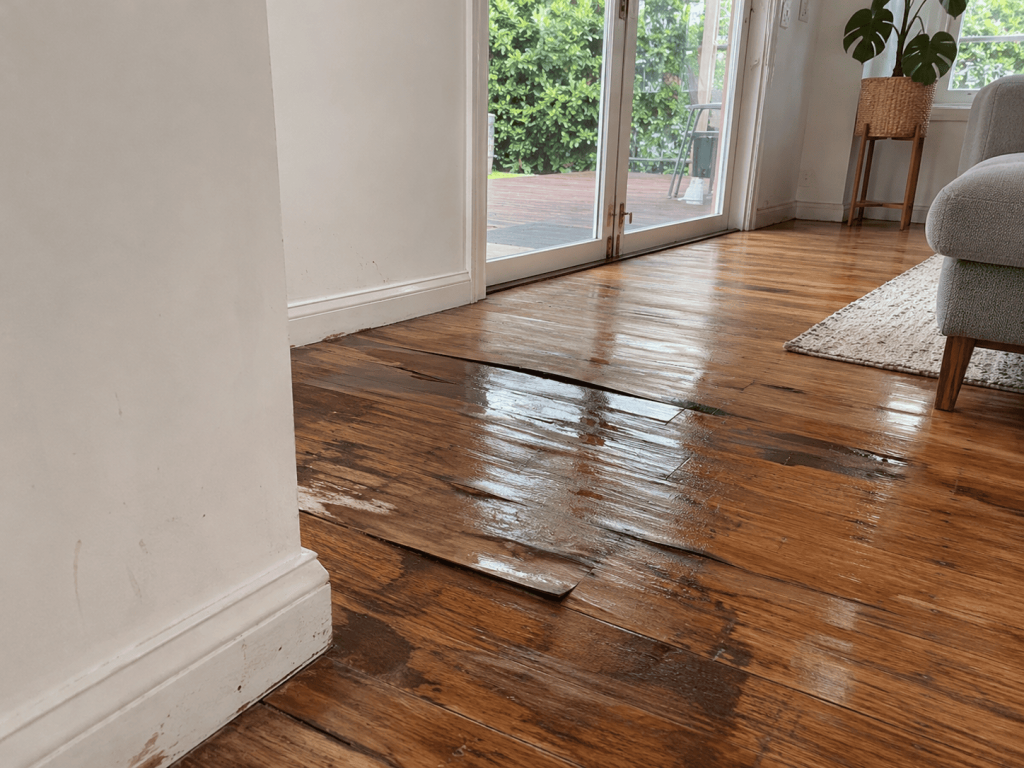
Timber is hygroscopic, which means it takes on and releases moisture from the air and from anything it touches. Water damage to floorboards rarely announces itself: the cell walls absorb water, the board swells across its width, and if it’s fixed at the skirting or glued to a slab, that expansion has nowhere to go. So it goes up.
Cupping, Crowning and Warping Explained
Cupping is when the edges of a board sit higher than the middle. The underside is wetter than the face, so the bottom swells, the top doesn’t, and the board curves. It usually means moisture from below: a wet subfloor, a leak under the floor or a slab that never dried.
Crowning is the reverse, with the middle higher than the edges, and it’s often self-inflicted. Sand a cupped floor before it’s dry and the sander shaves the raised edges; when the board later dries and flattens, the centre stands proud. That one doesn’t reverse.
Warping or buckling is the severe end, where boards lift off the subfloor and joints separate. That’s saturation plus time, often with heat thrown at it. Cupping can settle as boards equalise. Crowning from early sanding can’t.
Solid Hardwood, Engineered, Laminate and Hybrid
Solid hardwood is one piece of timber through its full thickness. It moves most when wet, but it’s the floor most likely to be saved because it can be sanded and refinished once it’s genuinely dry. Hardwood floor water damage is where patience pays, since dense species like jarrah hold their shape well and give up moisture slowly.
Engineered timber is a real timber wear layer over a plywood or fibreboard core. The face behaves like solid timber; the risk sits in the glue lines, where a wet core can delaminate and finish the plank. Plenty are dried in place when water never reached the core.
Laminate has a high-density fibreboard core, and once it swells it doesn’t return to its original thickness. Raised seams, soft edges and a springy feel usually mean replacement.
Hybrid and SPC planks are waterproof as a plank, not as a floor. Water runs through the joins and sits on the subfloor, so the planks are often reusable while the subfloor still needs drying.
How to Dry Wood Floors After Water Damage: Step by Step
The short answer to how to dry a wet wood floor is sequence: stop the water, extract what’s standing, move air, then measure.
Step 1: Stop the Water Source
Shut the water off at the isolation valve or meter first. If it’s coming from a storm or a sewer, stay out and call for help. Switch off power to affected circuits if you can reach the switchboard safely, then photograph everything, because your claim starts here.
Step 2: Remove Standing Water Fast
Water extraction is the biggest lever you have, since every hour of standing water is more moisture driven into the boards. Use a wet vacuum, mops and towels, working from the far corner back to the source. Don’t wait for the insurance process to finish before you start.
Step 3: Move Air Without Overheating the Floor
Air movement takes moisture off the surface and a dehumidifier takes it out of the air; the EPA suggests keeping indoor humidity between 30% and 50% to discourage mould. Heat is the trap. Blasting heaters dries the face of a board faster than the underside, widening the moisture gap that causes cupping. Keep the room at normal living temperature and keep the air moving. In Perth’s wet winter weather, opening windows can put more moisture in than it takes out.
Step 4: Lift Rugs, Furniture and Wet Carpet
Rugs trap moisture, furniture blocks airflow, and carpet and underlay act like a sponge on top of your boards. Soaked underlay usually has to go. The EPA is direct on this point: the subfloor under carpet has to be cleaned and dried too. Lift rather than drag, and slide foil under anything too heavy to move.
Step 5: Get a Floor Drying Specialist on Site
What you can see is the smaller half of the job. Moisture under boards, inside the subfloor and in the wall cavity can’t be judged by touch. A specialist reads it with meters, maps where it travelled and sets equipment to the actual readings. Flood Services Perth runs 24/7 across the metro area, states a one hour response, and assesses the floor free of charge.
What Not to Do When Your Wood Floor Is Wet
A wet floor rarely fails because of the water alone. It fails because of what gets done to it in the first day, and most of that is avoidable.
- Don’t sand a cupped floor before it’s dry, because you turn a reversible cup into a permanent crown.
- Don’t crank heaters or seal the room, because fast surface drying is the quickest way to a wave in the floor.
- Don’t trust your hand, since boards feel dry long before they are.
- Don’t run a domestic dehumidifier as your only tool, because it can’t pull a wet subfloor down.
- Don’t walk on buckled boards, mop with more water, or throw out damaged boards before your insurer has seen them.
- Don’t treat sewage-affected water as clean water. Contaminated water often means materials come out.
None of these are hard to avoid once you know them. If you’ve already done one, get the floor assessed before you write it off, because a specialist can tell the difference between a floor that’s damaged and a floor that’s finished.
How Professional Timber Floor Drying Works
Professional drying is a measured process, not a fan in the corner. The target comes from your own dry boards, and equipment stays until the readings get there.
Moisture Mapping and Thermal Imaging
Technicians take pin meter readings into boards at fixed points, and pinless meters scan across the floor without marking it. A thermal camera shows the cooler patches where water is evaporating, which is often where moisture travelled to rather than where it spilled. Together they build a map: before, during and at the end.
Air Movers, Dehumidifiers and Drying Mats
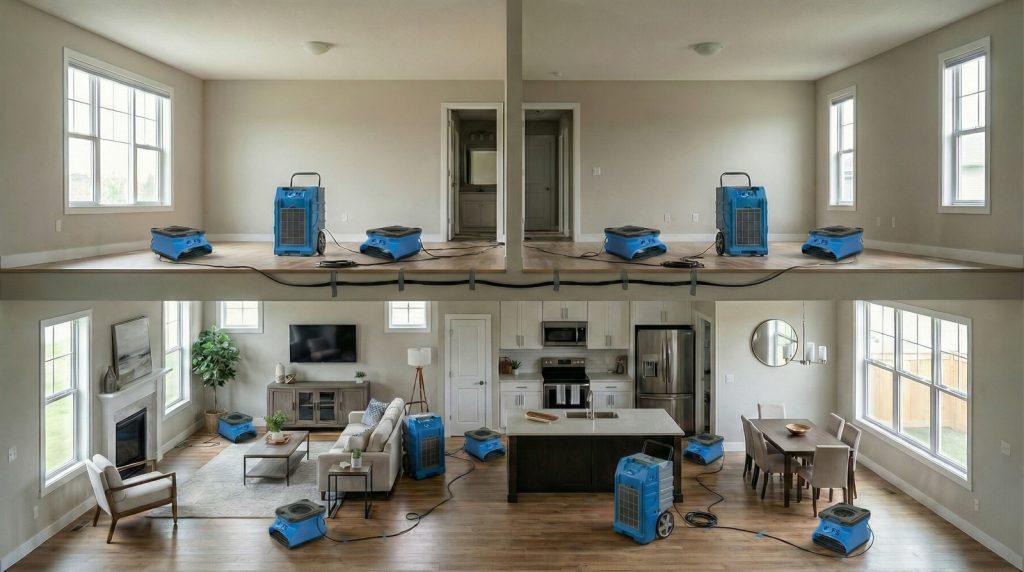
Air movers keep saturated air off the surface and low grain refrigerant dehumidifiers pull that moisture out of the air before it settles into the walls. Drying mats are the tool built for floorboards: a mat sealed to the floor creates a negative pressure chamber that draws moisture up and out of the boards. That’s how many floating and engineered floors get dried in place instead of pulled up. Where the subfloor can’t be reached with air, the floor has to come up, and on timber subfloors that can mean lifting a run of boards to dry the joists below.
How We Confirm the Floor Is Actually Dry
The IICRC S500 dry standard isn’t one number. It’s the reading from unaffected boards of the same species and construction in the same home, taken the same day, and affected boards have to come back to that range rather than just look dry. Readings are logged daily, equipment comes out when the numbers match and hold, and you get a written report, which is what an insurer asks for.
When a Wet Wood Floor Is Beyond Saving
Some floors can’t be saved, and it’s better to know early than to pay for a week of equipment on a failed floor. The signs are consistent: laminate with raised seams or soft, flexing boards, engineered planks with layers peeling at the joins, boards buckled off the subfloor with broken tongue and groove, water from a sewer or storm, mould on the underside or across the subfloor, and joists that are soft or crumbling.
Water-damaged floorboards that have lifted away from the subfloor rarely come back with drying alone. Replacement isn’t a failure of the drying, it’s the honest call, and usually the cheaper one by then. Keep one damaged board to match species, width and profile, and have the subfloor dried and verified before new flooring goes down.
Does Home Insurance Cover Floor Drying and Repairs?
Usually the drying is covered and the floor isn’t, and it comes down to the cause and your policy wording. Sudden escape of liquid from a pipe, hose, appliance or hot water system is the typical covered event; gradual leaks, failed waterproofing and neglect generally aren’t.
Flood is separate, and Australia has had a standard definition since June 2012: the covering of normally dry land by water escaping a lake, river, creek, reservoir, canal or dam. Most domestic policies offer flood cover as standard inclusion, inclusion with an opt-out, opt-in only, or not at all, and commercial policies generally exclude it unless opted in. Even then, storm or rainwater damage may still be covered, and your insurer can assess a claim to work out how the water got in. Take photos, keep damaged materials, ask for a written drying report, then read your policy disclosure statement. We can dry your floor and document it. We can’t tell you what your policy covers.
Final Thoughts
Wet timber isn’t a lost cause. Stop the water, extract what’s standing, move air without adding heat, clear the rugs and underlay, and get readings on the boards before you assume anything. How to dry wood floors after water damage in Perth comes down to speed and measurement: the sooner the water is out and the readings are taken, the more floor you keep.
Flood Services Perth handles water damage restoration and timber floor drying across the Perth metro area, 24 hours a day, with a stated one hour response and a free damage assessment. Our professional flood restoration team also deals with the insurance paperwork directly, so you’re not translating drying logs for an assessor. Call us on 08 9468 8413 or book us online and get the floor measured rather than guessed!
Frequently Asked Questions
1. How long does it take for wood floors to dry after water damage?
Three to five days is the common range for a wet structure, and timber floors sit in the slowest class, often running a week or more. Readings decide when it’s finished, not the calendar.
2. Can water damaged timber floors be saved, or do they need replacing?
Solid hardwood often can be saved, and engineered floors can if water never reached the core. Laminate usually can’t, because a swollen fibreboard core doesn’t return to its thickness. Buckled boards, sewage and subfloor mould generally mean replacement.
3. Should I run a heater or a fan on wet timber floors?
A fan, yes. A heater, no. Air movement and dehumidification dry evenly, while high heat dries the face before the underside and makes cupping worse.
4. What is cupping on a timber floor, and can it be reversed?
Cupping is when board edges rise above the middle because the underside holds more moisture than the face. Mild cupping often settles over the following weeks as boards equalise. Sanding too early causes crowning, which can’t be reversed.
5. Does engineered or laminate flooring dry differently to solid hardwood?
Yes. Engineered timber behaves like solid timber at the surface but has a glued core that can delaminate if it stays wet, so drying has to be monitored closely. Laminate swells permanently.
6. How do I know my floor is actually dry, not just dry to the touch?
You measure it. A moisture meter compares affected boards with unaffected boards of the same species and construction, and the floor is dry when those readings match and hold across consecutive checks.
7. When should I call a professional timber floor drying service in Perth?
As soon as the water is off and the standing water is out. The EPA’s 24 to 48 hour window is about drying materials before mould establishes. Call sooner if water came from a sewer or storm, or if boards are already lifting.