If your property has been hit by a burst pipe, a storm, or an overflowing appliance, you already know that water does not wait around. It soaks into floors, creeps up walls, and works its way into furniture before you have had a chance to grab a towel. What you do in the next few hours matters more than most people realise.
Getting the right drying equipment in place quickly is what separates a full recovery from a drawn-out repair job. But with so many products on the market, it is easy to grab the wrong gear and wonder why things are still damp three days later.
In this guide, we walk you through the 4 essential pieces of water restoration drying equipment used by professional restoration teams, what each one does, and why using the right combination makes all the difference. Whether you are considering drying equipment hire Perth wide or just want to understand the process better, this is your starting point.
Why the Right Equipment Matters
Here is something most people do not know: mould can start growing within 24 to 48 hours of a water damage event. Water works its way into plasterboard, timber framing, and sub-floor materials quickly, and once mould takes hold, you are looking at a much bigger and more expensive problem.
Using the wrong equipment, or simply not enough of it, extends your drying time and increases the chance of hidden moisture causing damage you cannot see. The four pieces of water restoration drying equipment below are what professional restoration teams rely on every day, and they work best when used together.
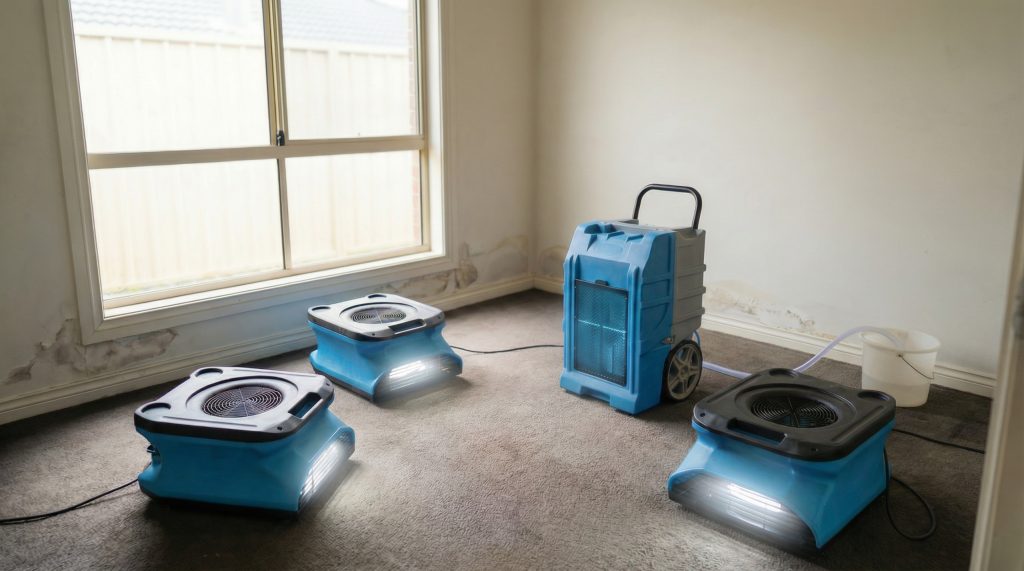
The 4 Essential Drying Equipment for Water Damage
1. Blower (High-Velocity Air Movers)
Think of blowers as the first responders of any water damage drying job. These high-velocity air movers push a powerful, focused stream of air across wet surfaces, pulling moisture up from carpets, hard flooring, walls, and sub-floor materials and pushing it into the surrounding air.
You might be wondering: can I just use my household fan? The short answer is no. A standard fan simply moves air around the room. A professional blower generates the kind of concentrated, directional airflow needed to actually draw moisture out of saturated building materials. It is a completely different level of performance.
Blowers and dehumidifiers work as a team. The blower drives moisture out of the materials; the dehumidifier captures it from the air. Without blowers in the setup, your dehumidifier has to work much harder and your drying timeline blows out significantly.
When it comes to drying equipment hire Perth wide, blowers are the first piece of kit you need on site. Rental packages typically start at three fans for a single bedroom or office room and scale up to 50 units for large commercial spaces of around 200 square metres.
Best for: Carpet drying, hard floor drying, accelerating structural drying after water extraction, and making sure your dehumidifier works as efficiently as possible.
2. Dehumidifier (Large Industrial Units)
Once your blowers are driving moisture out of wet materials and into the air, your dehumidifier takes over. These industrial units draw moist air across a cooled coil, condensing the water vapour and draining it away. The dried air then circulates back into the room to absorb more moisture, and the cycle keeps going until the affected area reaches a safe moisture level.
It is worth knowing that industrial dehumidifiers are in a completely different league to the consumer-grade units you find at a hardware store. A professional unit can process far greater volumes of moisture per day, which is exactly what you need when you are dealing with real flood or water damage rather than a bit of winter humidity.
Professional restoration teams in Perth rely on large industrial dehumidifiers suited to Perth’s warm climate conditions. Importantly, dehumidifiers and blowers need to be properly sized and paired to the area you are drying. A useful rule of thumb: a bedroom or office of around 12 square metres needs 1 dehumidifier and 3 fans, while a ground floor of around 50 square metres requires 4 dehumidifiers and 12 fans. No guesswork involved.
Best for: Removing airborne moisture, preventing mould, and handling residential and commercial flood restoration at any scale.
3. Moisture Meter
This one is easy to overlook, but it is arguably the most important tool in the kit. A moisture meter is a handheld device that measures the moisture content of building materials, including carpet, timber, plasterboard, concrete, and sub-floor materials. And the reason it matters so much is simple: you cannot tell whether your drying job is done just by looking or feeling.
Hidden moisture is one of the most common reasons people end up with a mould problem weeks after what looked like a successful recovery. The surface feels dry, the equipment gets packed up, and then the damage that was lurking behind the skirting board or under the flooring makes itself known. A moisture meter removes the guesswork entirely.
Good news: moisture meters are widely available through professional drying equipment hire Perth services, so homeowners and property managers can access the same tools the pros use. Hiring one alongside your blowers and dehumidifiers lets you accurately track your drying progress and verify the job is genuinely done before you pack up the gear. As a bonus, documented moisture readings can also support your insurance claim by providing clear evidence of the drying outcome.
Best for: Tracking drying progress, locating hidden moisture in walls and floors, confirming restoration is complete, and providing documentation for insurance claims.
4. Carpet and Floor Dryer
Wet carpet is one of the most common water damage scenarios we see across Perth homes and businesses, and carpet and floor dryers are the purpose-built solution. These units push high-volume airflow directly across the carpet surface and, where needed, beneath it, drawing moisture out of the pile, the underlay, and the sub-floor materials underneath.
Here is the practical advantage: rather than pulling up your carpet and waiting for it to dry on a clothesline, a professional carpet and floor dryer can dry spills and flood-affected flooring efficiently in place. That means less disruption, a shorter turnaround, and a much better outcome for your carpet overall.
This is targeted, practical water restoration drying equipment for homeowners and property managers handling a contained event. When sourcing drying equipment hire Perth wide, look for a provider that offers carpet and floor dryers as part of their range, with flexible pickup and delivery options across the metro area.
Best for: Wet carpet drying, spill and flood cleanup on hard and soft flooring, and surface-level moisture removal once standing water has been extracted.
How These Tools Work Together
None of these four pieces of equipment works in isolation. The key to effective water damage drying is using them as a coordinated system, in the right order.
Here is how a proper drying setup works:
- Remove standing water first. Before any drying equipment goes on, get the bulk water out using buckets, an extraction pump, or a wet vacuum.
- Set up your blowers across all wet surfaces to start driving moisture out of carpet, flooring, and walls and into the ambient air.
- Run your industrial dehumidifiers alongside the blowers to continuously capture and remove that moisture from the air so it does not settle back into your materials.
- Check daily with your moisture meter to track progress, spot any hidden pockets of moisture in walls or sub-floors, and confirm the drying is heading in the right direction.
- Take a final reading before packing up the equipment to verify the job is genuinely done.
This is the process that separates a thorough, professional water damage recovery from a surface-level dry that leaves problems hiding in your walls for weeks.
Summary
When water damage hits, the four pieces of equipment covered in this guide, blowers, industrial dehumidifiers, moisture meters, and carpet and floor dryers, are what stand between a full recovery and a prolonged, costly repair. Each tool plays a specific role, and they work best as a coordinated system. Blowers drive moisture out of saturated materials, dehumidifiers pull it from the air, moisture meters confirm the job is genuinely done, and carpet and floor dryers handle the most common surface-level damage found in Perth homes and businesses.
When it comes to drying equipment hire Perth wide, Flood Services Perth is the team locals trust. As one of Perth’s leading water damage restoration companies, they cover every suburb across the metro area. They are available 24/7 and can be onsite within the hour. Their full range of water damage restoration equipment, including industrial dehumidifiers, high-velocity blowers, moisture meters, and carpet and floor dryers, is available for hire with flexible pickup and delivery options.
Do not wait! Call us at 08 9468 8413 or book your service online today!